
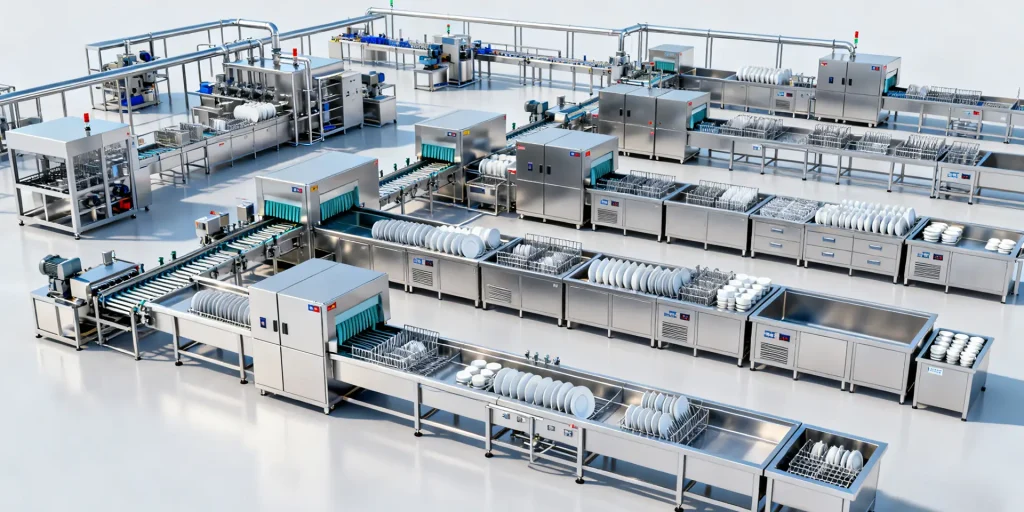
An ultrasonic dishwasher is a device that uses ultrasonic cleaning principles to clean tableware. With its high efficiency, water-saving features, and minimal damage to tableware, it is widely used in households, the catering industry, and commercial settings. The following provides a detailed introduction from the perspectives of working principles, core components, advantages, applicable scenarios, and precautions:
1. Working Principle
The core of an ultrasonic dishwasher is the ultrasonic vibration system:
An ultrasonic generator converts electrical energy into high-frequency mechanical vibrations (typically above 20 kHz, with commercial models reaching 40–60 kHz). These vibrations propagate through the water (or specialized cleaning solution) in the washing tank, creating numerous tiny bubbles (cavitation bubbles). These bubbles rapidly form, expand, and collapse under high-frequency vibrations. The collapse generates localized high pressure (up to thousands of atmospheres) and intense shock waves, akin to countless tiny “shock waves.” These shock waves penetrate into the crevices, grooves, and holes of tableware—areas that are difficult to reach with traditional hand washing or spray rinsing—to remove grease, food residues, bacteria, and other contaminants, achieving comprehensive cleaning.
2. Core Components
Ultrasonic Generator:
Provides high-frequency electrical signals, serving as the “power source” for generating ultrasonic waves. It can adjust frequency and power to accommodate different levels of dirt on dishes.
Transducer (Vibrator):
Installed at the bottom or side of the washing tank, it converts electrical signals into mechanical vibrations, serving as the “converter” of ultrasonic energy. It typically uses piezoelectric ceramic materials (such as barium titanate or lead zirconate titanate).
Washing Tank:
Holds dishes and cleaning solution, typically made of stainless steel (e.g., 304 stainless steel), which is corrosion-resistant and can transmit vibration energy. Its shape and capacity are designed based on the application scenario (30–50 L for household use, up to hundreds of liters for commercial use).
Auxiliary systems:
Heating device: Some models have built-in heating functionality (40-60°C), which increases water temperature to enhance grease solubility and improve cleaning efficiency.
Filtration system: Filters residues after cleaning to reduce secondary staining and extend the lifespan of the cleaning solution.
Control system: Adjusts cleaning time, temperature, power, and other parameters via buttons or a touchscreen. Some smart models support scheduling and automatic drainage functions.